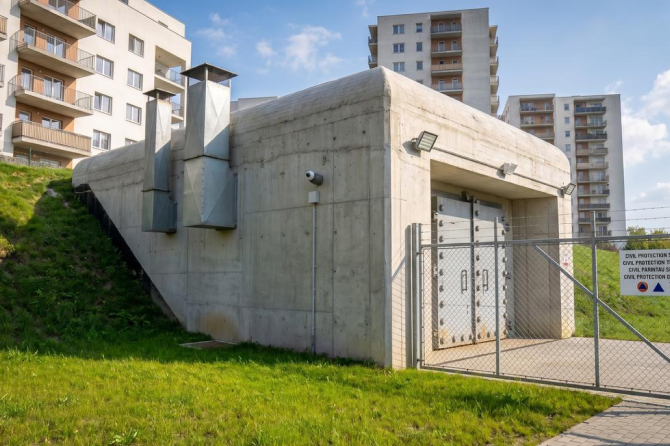

For three decades, civil defence in Poland existed mostly on paper. The structures were there in the documents, but the real resources, meaning shelters, plans and supplies, simply were not, not in most municipalities. There were no threats, there was no money, and there were no rules forcing anyone to act. On 1 January 2025 that ended overnight. The Act on the Protection of the Population and Civil Defence came into force, and thousands of local governments suddenly faced a task they had never carried out before. Not "modernise the system," but build it from zero.
This article sets out what a municipality needs to have in place, where to start, and where it is easiest to make the kind of mistake that only bites back once a crisis hits.
A law that took effect with almost no transition period
The Act of 5 December 2024 on the Protection of the Population and Civil Defence is one of the most important pieces of legislation of this term. It filled the legal vacuum left when the earlier civil defence rules were repealed, and for the first time in years it created a coherent, round-the-clock protection system that works the same way in peacetime as in war.
The catch is that the rules took effect almost immediately after signing, with no real transition period. Local government experts put it plainly: it was like handing over a house in a bare shell state, with no doors, windows or fittings. On top of that came a second difficulty. The law imposes the same duties on a rural municipality of 3,000 people and a city of 300,000. The identical catalogue of tasks lands on an office with 30 employees and on one with fifteen hundred.
For a municipality that means one thing: you cannot wait this out. You have to move in stages, but you have to start now.

The four pillars of a municipality's new duties
The tasks in the law fall into four areas. It helps to treat them as a checklist.
1. Warning and alerting. The municipality is responsible for detecting threats and for notifying, warning and alerting residents. That means not only sirens but, in the long run, clear voice messages and alerts sent to phones. The key audit question is whether the alerting systems actually work, or whether they merely exist on paper in the register.
2. Resources for at least three days. This is the most tangible obligation. Article 33 of the Act requires municipal leaders to create and maintain population protection resources: stocks of water and the means to treat it, backup sources of power and fuel, food, sanitary supplies and medicines. The benchmark is clear. The resources must be enough to sustain critical tasks for at least 3 days of a threat lasting. A municipality can do this on its own or in agreement with other bodies.
3. A register of entities and resources. You cannot manage what you have not counted. The municipality keeps a register of the population protection entities and resources in its area, from equipment and warehouses to people and their readiness. It is the foundation every later plan rests on.
4. Shelter, meaning collective protection facilities. The municipality plans the number and capacity of collective protection facilities for its residents. This is the hardest and most expensive pillar, which is exactly why it gets its own section below.
The billions are there. But not so easy to spend
To finance their own civil protection tasks, municipalities are meant to receive earmarked grants from the state budget, covering up to 100 percent of the cost. Under the "Protection of the Population and Civil Defence" programme for 2025 and 2026, the government earmarked more than 4.6 billion PLN for local governments, as part of a total programme budget exceeding 16.7 billion PLN. The scale looks impressive.
Reality proved more complicated. The money did not reach municipal accounts until September, in some cases October 2025, yet the rules required investments to be completed and settled by year end. Suppliers read the market and priced accordingly: the cost of civil protection equipment rose by as much as 30 percent within a few months. Almost 80 percent of the surveyed cities reported equipment shortages on the market, and more than half flagged the refusal to let them carry unspent funds into the following year.
The result was predictable. Municipalities bought first what could be bought fast: generators, mobile power and water treatment stations, pneumatic tents, camp beds. Shelters, which require longer procedures, slipped down the list. That is rational under time pressure, but a system that has generators and blankets and nowhere to shield people from a blast wave is not a complete system.
The staffing problem: who is supposed to organise all this?
This may be the biggest barrier of all, and the one talked about least. The law imposes dozens of concrete duties, from keeping registers, through running exercises, to maintaining protective structures. A large city can spread that across a small department. A rural municipality often has a single employee handling it on a fraction of a post, and sometimes there is nobody to do it at all. You cannot buy staff overnight, so the municipalities that want a working system in five years have to start training their own people now, not only the ones formally responsible for civil defence but the technical staff who manage the buildings.
A concrete case shows the pattern well. Under its "Building a local civil defence system" project, the municipality of Ciężkowice bought, among other things, a rescue and firefighting vehicle for the volunteer fire service, heavy equipment, four generators, and re-equipped its services with radios, AED defibrillators and lighting. An integral part of the project was training for municipal staff, firefighters, village heads, councillors, teachers and local community leaders. This reflects the direction most municipalities are taking: material resources and staff training ahead of investment in shelter infrastructure. It is a sensible approach under time pressure, but it does not replace the long-term work of building physical places of protection.
Collective protection facilities: from inventory to S and U categories
The new law tidied up the definitions. A structure, or part of one, recognised as a protective structure is classed as either a shelter or a cover, and given a resistance category:
- Covers (U-1, U-2, U-3): these protect, in turn, against shrapnel and small-arms fire (U-1), additionally against gamma radiation from radioactive fallout (U-2), and in category U-3 also against the effects of an overpressure wave (at least 60 kPa).
- Shelters (S-0, S-1, S-2, S-3): enclosed, airtight structures fitted with filter-ventilation equipment, with rising resistance to blast overpressure (from 0.03 MPa for S-0 up to the highest thresholds for S-3).
For shelters, the Ministry of the Interior regulation requires, among other things, filter-ventilation capable of generating and holding internal overpressure, and of switching quickly from drawing outside air to a closed circuit. This is exactly where many "shelters" from the last century fall short: walls too thin, concrete of too low a grade, or ventilation that is gravity-based only and therefore useless in the event of contamination.
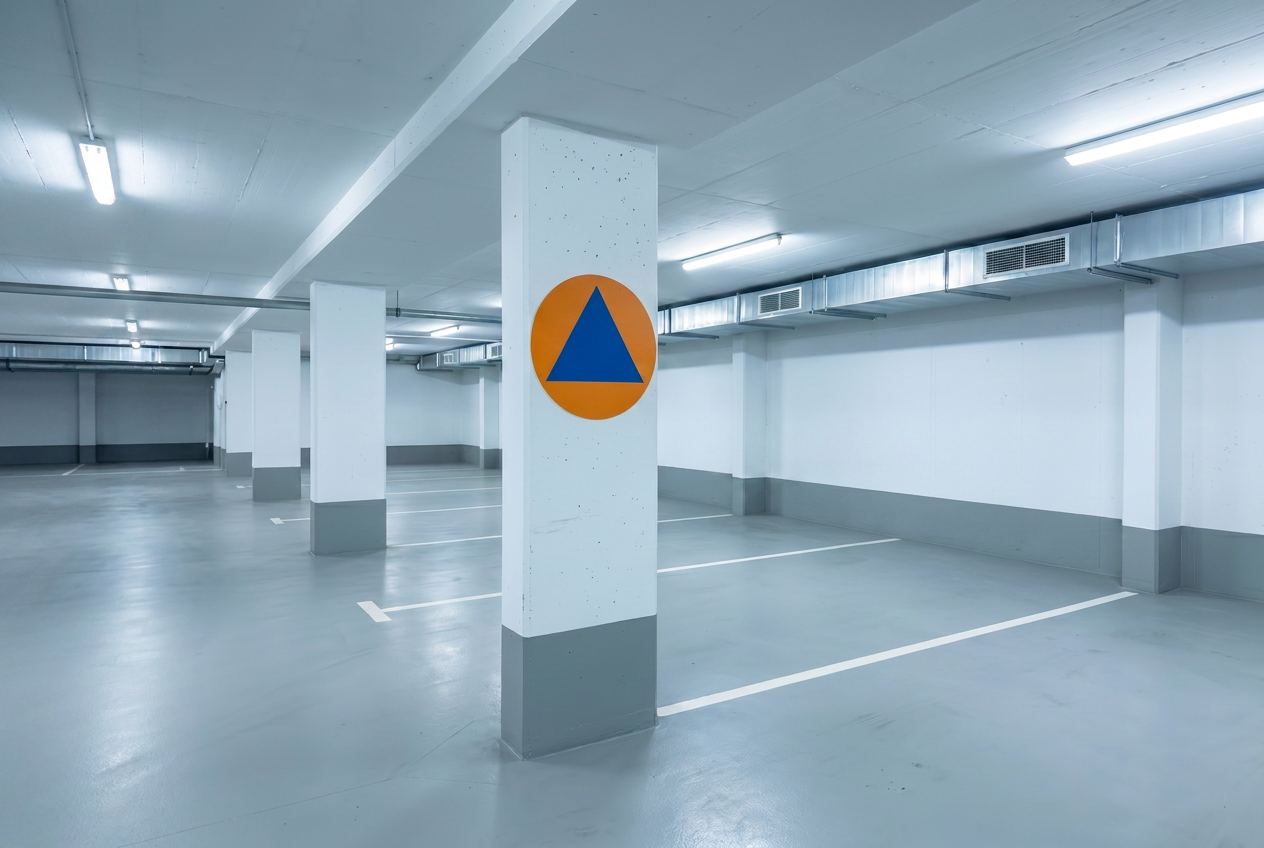
There are also temporary shelter points (MDS), an intermediate option in which, for example, an underground floor or a garage is prepared so that it can take people in if needed. The rules also allow buildings within a radius of up to 500 m to share a facility. A Council of Ministers regulation, in force since 21 August 2025, allows a protective structure to be designated in a public building that has at least one underground floor. That opens the way to adapting underground car parks, basements and technical floors.
The scale of the problem, however, is unforgiving. A 2023 inventory showed that only 1.43 million people could find shelter, in a country of more than 38 million. That is under 4 percent of the population.
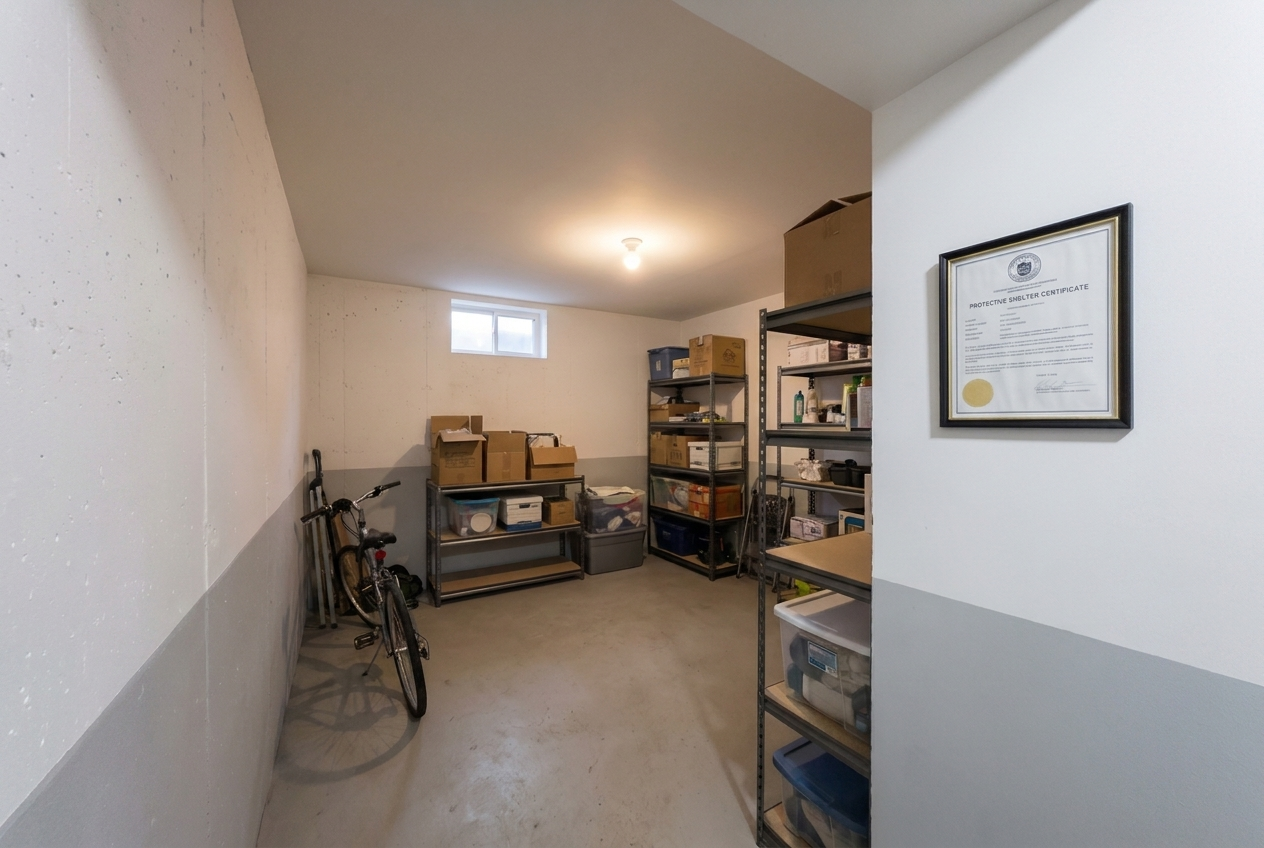
The practical takeaway for a municipality is simple. The first step is not building a new shelter but auditing what already exists: basements, public buildings, structures listed in the old records. You need to check which of them can realistically be adapted, and which are shelters in name only.
The most common traps: why "on paper" is not enough
Three mistakes come up most often:
- A register without verification. Putting a facility on a list does not mean it meets the standards. Without a technical assessment, a "shelter" will protect no one in a crisis and will formally drop off the register at the first inspection by the State Fire Service or the building supervision authority.
- Equipment without organisation. A generator that stands there but has no auto-start and no maintenance schedule does not secure continuity. The device is present; the procedures and servicing are not necessarily.
- A plan without communications and logistics. The system only works once the authorities, the entities and the resources are tied together by procedures, communications and a shared goal. A catalogue of facilities on its own is not yet a system.
It is worth keeping the wider context in mind. Since March 2025, Poland has already been operating under two states of national defence readiness, and the range of tasks grows as the situation escalates (peace, crisis, war). The shift from population protection to civil defence is not automatic. It has to be planned in advance, in peacetime.
Where to start: a practical order of steps
For a municipality starting from zero, a simple sequence works:
- Inventory. Count your resources, entities and potential collective protection facilities. Without this, every plan is guesswork.
- Technical audit of facilities. Commission an assessment: which structures can be adapted to category S or U, and which are better replaced with an MDS.
- Priority matrix. Decide which facilities and systems are critical to life and which are "merely" important. That lets you spend the budget sensibly.
- A three-day resource plan. Water, power, fuel, medicines, food, together with a rotation and replenishment schedule.
- Funding. Track the calls for applications from the Population Protection Fund and regional programmes. The rules allow money to be shifted between areas and reward dual-use investment.
- A continuous improvement cycle. Plan, prepare, test, correct. Servicing and documentation are not bureaucracy; they are the condition for the equipment to work on the day it matters.

Where the control layer fits into all this
Once a municipality reaches the stage of adapting a specific facility, it quickly turns out that the hardest part is not the shell of concrete, doors and valves. The harder question is whether the facility will actually work when it has to. The filter-ventilation has to switch to closed-circuit mode. The overpressure has to be maintained. Someone has to see the state of the installation in real time.
This is the control layer: automation, monitoring and the integration of devices into a single working system. Without it, even a well-designed facility remains a set of individually sound but uncoordinated parts. This is an area where we can help in a joined-up way. We support municipalities along the whole path: from a technical audit and expert assessment of existing facilities, through the construction side, to the logic layer, meaning control, supervision and installation monitoring. That way the individual elements do not each go their own way but add up to one coherent, working solution, and the municipality does not have to coordinate several separate contractors.
Poland is building from scratch a system that other countries developed over decades. It is difficult, costly and time-consuming. But the alternative, having no system at all, is costlier in an entirely different sense.
Planning to adapt a protective facility, or preparing documentation for a designer? Get in touch and we will walk you through the audit, the concept and fitting the control layer into your project.