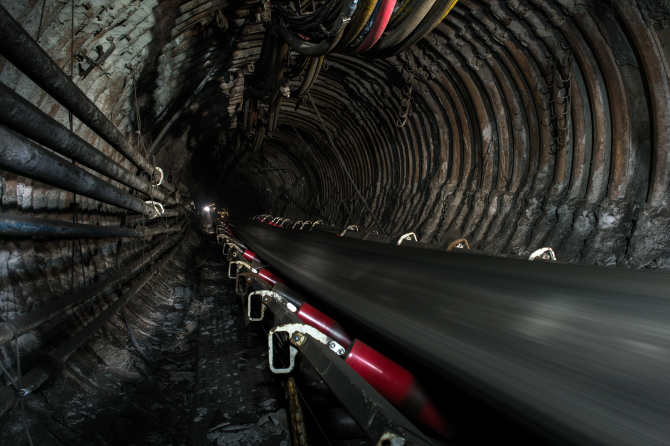
Before anyone in Europe seriously began thinking about sensors for shelters, Polish mines already had several decades of experience monitoring the environment in conditions that destroy typical electronic devices. High pressure, extreme humidity, dust, vibration, explosive atmospheres, limited communications, no service access for weeks on end — this is everyday life in underground coal mining. And that is precisely why mining is the best possible school for engineers designing monitoring systems for civil-protection facilities.
Mining as a laboratory for extreme sensing
For decades, Polish underground mines have run extensive gas-monitoring and telemetry systems, classified under mining law as mine safety systems. These are not academic projects — they are systems on which the lives of hundreds of people underground depend every day.
A typical gas-monitoring system in an underground coal mine continuously measures: the concentration of methane (CH₄), carbon monoxide (CO), carbon dioxide (CO₂), oxygen (O₂), temperature, humidity and air-flow speed. Data from hundreds or thousands of measurement points reaches a central control room in real time. When alarm thresholds are exceeded, power to electrical equipment in the affected zone is automatically cut off, and alarms and evacuation procedures are triggered. In mines with a higher degree of methane hazard, these systems operate with redundancy — several parallel transmission channels and backup power — because a failure of the monitoring system at a moment of danger can mean catastrophe.
Five lessons from the mine that will change how we think about shelters
Lesson 1: A sensor must outlast the situation it is intended for
In a mine, a methane sensor must operate continuously for months without a service visit, in an environment where coal dust, water and vibration destroy standard electronics. The answer is special sealed enclosures (IP67 and above), intrinsically safe electrical circuits (Ex category) and materials resistant to aggressive chemicals. For shelters the conclusion is obvious: a sensor installed in a protective structure and left unused for years must be capable of immediate, flawless operation the first time it is switched on after a long period of inactivity. These are quite different requirements from those for a typical industrial sensor installed in a sterile factory environment.
Lesson 2: Redundancy is not a luxury, it is a necessity
Mining has taught us that in critical environments there is no room for a single point of failure. Gas-monitoring systems use a star-shaped transmission-network topology, in which the failure of one node does not paralyse the whole system. Central telemetry stations have backup power, duplicated servers and independent communication channels. For shelter monitoring systems this means that a single CO₂ sensor powered from the municipal grid with no backup is not a solution but an illusion of safety.
Lesson 3: Intrinsic safety is the absolute minimum in explosive atmospheres
In spaces where flammable gases can accumulate (methane, CO), every electrical device must meet intrinsic-safety requirements, so that not even an electrical spark could trigger an explosion. In shelters, where a ventilation failure can lead to a build-up of dangerous gases, the same principle applies. The Ex categories (ATEX) familiar from mining should become the standard for electronics installed in the sealed spaces of protective structures.
Lesson 4: Humans are the weakest link in an alarm system
For many years, miners were warned of methane by canaries — birds that die at concentrations imperceptible to humans. Modern systems are many times more sensitive than human senses, but their effectiveness depends on whether the alarm reaches the right person at the right time and whether that person responds according to procedure. Over the years mining has developed alarm protocols, notification hierarchies and automatic shutdown procedures, precisely because relying on a person's subjective assessment of danger under stress leads to tragedy. The same principles should apply in shelters: automated procedures, unambiguous alarm signals, and predefined roles and responsibilities.
Lesson 5: Data without interpretation is just noise
Modern mine monitoring systems generate gigabytes of data a day. Their value emerges only at the point of analysis: identifying trends, detecting anomalies, predicting failures before they happen. The machine-learning algorithms used in modern mine safety-management systems can detect subtle changes in atmospheric parameters that herald danger dozens of minutes before the situation becomes critical. The same approach — predictive analytics combined with a dense network of sensors — should make its way into advanced management systems for protective structures. A sensor that measures CO₂ concentration and displays the result on a screen is far less valuable than a system that analyses the trend in rising CO₂, correlates it with the number of people in the shelter and the ventilation rate, and proactively tells the operator when it is time to switch to filtration mode.
Technology transferability: what is already moving from the mine to the shelter?
Several key sensing technologies, tried and matured in mining, are directly adaptable to shelter applications.
Electrochemical and catalytic sensors for measuring gas concentrations (CH₄, CO, CO₂, O₂), used in mines since the 1980s, are now available in miniature, low-power versions ideal for integration into building-management systems. Real-Time Location Systems (RTLS), developed for mines to track miners' positions underground, can track the distribution of people in a shelter and optimise air distribution. Intrinsically safe communication systems, anemometers for measuring airflow, vibration recorders for assessing structural integrity — these are all mining technologies that can work in a shelter environment with no major modification.
What still needs to change?
Direct transfer of mining technology to shelters runs into one serious barrier: in mines, sensors are operated by trained specialists who understand how they work and know how to interpret the readings. A shelter in a multi-family building will be managed by a property administrator who has most likely never heard of a filter-absorber. The key, then, is not only to transfer the technology but also to simplify and automate it to a level that demands no specialist knowledge from the operator. A system that diagnoses the condition of the filters by itself, tests valve tightness by itself and reports its readiness by itself is a goal that mining's experience in automating monitoring makes achievable.
Conclusion: decades underground as an advantage
Polish underground mining represents several decades of experience operating in conditions where standard technology fails. Knowledge about sensor durability, system redundancy, alarm design and data integration is an invaluable resource for a shelter-infrastructure system being built from scratch. It is worth drawing on it rather than reinventing the wheel.