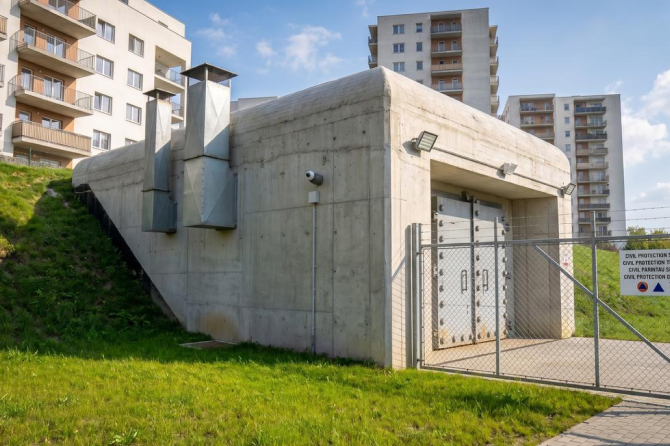
The word "shelter" conjures up a concrete Cold War bunker — dark, damp, filled with metal bunks. A modern protective structure is something entirely different. It is a complex engineered system in which every element — from the thickness of the walls, through the air filters, to the sewage installation — is the result of precise threat analysis and dozens of trade-offs between protection and the ability of people to stay there for a long time. Let's break this system down into its parts.
The shell: a structure that has to survive
The foundation of every shelter is its structure — literally, because the loads it must withstand are completely different from those in a typical building. Modern design standards for protective structures divide them into resistance categories according to the threats they are meant to protect against: from concealment spaces offering protection against shrapnel and the blast wave of conventional explosions, through shelters resistant to detonations at a certain distance, to structures adapted for more extreme scenarios.
The minimum thickness of reinforced-concrete walls in protective structures is 30 cm, though for higher resistance classes it is considerably greater. The material must offer not only compressive strength but also the ability to absorb the energy of a blast wave. Hence the use of special concrete mixes with additives that improve ductility. The slab above the shelter must withstand the static load of the soil (often several dozen tonnes) and the dynamic impact of the blast wave. The entrances — one of the critical points of any shelter — are protected by special blast doors, often weighing more than several hundred kilograms, with multi-point locking and seals that ensure airtightness.
The lungs of the shelter: the filtration-ventilation system
If a shelter had a single most important device, it would be the filtration-ventilation system. In a sealed, airtight space full of people, air becomes a critical resource. Its quality directly determines survival.
A modern filtration-ventilation system works in three modes. In normal mode it supplies fresh air from outside (15–25 m³/h per person), maintaining a slight overpressure inside the shelter that prevents contaminated air from seeping in through leaks. In protective filtration mode (activated when external contamination is detected), the air passes through a multi-stage purification system. First through an air intake protected by a blast valve, then through an expansion chamber and a dust filter (which traps dust and radioactive particles), and then through a filter-absorber filled with activated carbon. This element absorbs toxic chemical compounds and chemical warfare agents. HEPA-class filters, or at least F7–F9, provide filtration efficiency of up to 99.97% for particles of 0.3 microns. In an exceptional threat, the system switches to full isolation mode. The external air inlets close hermetically and the shelter operates on a stored oxygen reserve.
The ventilation system can run on electric power (electric fans) or manually with a hand crank, ensuring continuity even with a complete loss of power. Stale air leaves the shelter through exhaust dampers (WKS), which open automatically once a set internal overpressure is reached.
Energy: independence from the grid
A shelter that loses power at the first grid outage is not a shelter — it's just an underground room. Energy independence is one of the requirements that allow no exceptions. In practice this means a generator with an adequate fuel reserve or advanced UPS systems. The key installations — ventilation, emergency lighting, communications and instrumentation — must operate for at least 72 hours without external power.
The eyes and ears of the shelter: instrumentation
A modern shelter must "know" what is happening inside and outside. The instrumentation includes: air temperature and pressure sensors, gas-composition sensors (CO₂, O₂, CO concentrations), humidity meters and, as optional equipment, instruments for measuring chemical and radioactive contamination. Data from these sensors goes to a central monitoring station, and modern systems equipped with AI algorithms can automatically adjust the intensity of filtration ventilation, send alerts about the need to replace filters and optimise energy use. The entrance hatches are fitted with opening sensors; some solutions offer remote system management via a mobile app — particularly useful for shelters used only occasionally, which need regular functional tests without staff having to be physically present.
Water and sewage: the logistics of survival
A prolonged stay by dozens or hundreds of people in an enclosed space generates enormous demand for water and places demands on the sewage system. The new rules set requirements for water-and-sewage installations that ensure hygiene and safety: mandatory sanitary facilities with a number of toilets proportional to the shelter's capacity, drinking-water tanks for the duration of autonomous operation, and appropriate systems for treating and discharging wastewater that can be used without a connection to the municipal network.
Communications: not being cut off from the world
A shelter must maintain communication with the outside — with crisis-management authorities, other shelters and emergency services. The communication requirements include: radio systems able to operate amid electromagnetic interference, data transmission resistant to failures of ground infrastructure and, in higher-class structures, electromagnetic shielding (a Faraday cage) protecting the internal electronics against an electromagnetic pulse (EMP). The State Secure Communications System (regulated by the amendment to the act) is intended to provide reliable mobile communication, including classified communication, for the services and bodies responsible for security.
The human space: people at the centre
Despite its technical sophistication, a shelter must remain a place where people can survive not only physically but also psychologically. A minimum area of 2 m² per person is the lower limit; in practice, good designs provide more. Seating or lying-down places, adequate lighting, access to drinking water and food (the rules require supplies for a set period), separate zones for children and the elderly, access for people with disabilities — these are all elements that must not be forgotten while focusing solely on technical parameters.
The hatch cover: discretion and strength at once
The element most often omitted from descriptions of shelters, yet of enormous practical importance, is the hatch. Modern hatch covers can be installed flush with ground level, covered with a layer of soil or paving and rendered practically invisible. At the same time they must withstand loads of up to 60 tonnes (e.g. from heavy vehicles) and provide a hermetic seal. Doors and hatches are individually tailored to the specifics of the structure.
The shelter as a living system
A shelter is only as effective as its state of upkeep. Regular inspections, testing of filtration-ventilation systems, checking valve tightness, verifying the generator's fuel reserves, checking filter expiry dates — these are all the things that determine whether the structure will work as designed when a threat arrives. A modern shelter is not a building you can forget about once built; it is a system that requires constant maintenance and operational readiness.